ECOMAR
  • Home
  • Climate Change
    • Impacts on Corals & Turtles
    • Programs
      • Adopt A Beach>
        • Adopted Beaches
        • Adopt A Reef>
          • Adopted Reefs
          • Coral Watch>
            • Coral Watch Programs
              • MAR Coral Watch
                • Coral FAQs
                  • Healthy vs. Unhealthy Coral
                    • Coral Network
                    • Lionfish>
                      • History
                        • COMPACT Lionfish Project
                          • GCFI Fisherman Exchange
                            • Caribbean Strategies
                            • Reef Rally
                              • Turtle Watch>
                                • Sea Turtle Census>
                                  • Turtles of Belize
                                    • In-Water Observations>
                                      • Photo ID
                                      • Nesting Beach Observations
                                        • Stranded Turtles
                                          • In-Water Scientific Surveys
                                          • Turtle Network
                                            • Turtle Research>
                                              • Gallow's Point
                                                • Robinson Point
                                            • Submit Report
                                              • Coral Bleaching
                                                • In-Water Turtle Observation
                                                  • Nesting Beach Observation
                                                    • Stranded Sea Turtle
                                                      • Lionfish
                                                      • Questionnaires
                                                        • Marine Guides
                                                          • Fisherman
                                                            • General Public
                                                              • Coastal Property Owners
                                                                • Visitors
                                                                • St George's Caye
                                                                  • Field School
                                                                    • Archaeology Project
                                                                    • About Us
                                                                      • Partners
                                                                        • Volunteers
                                                                          • Publications
                                                                            • Blog
                                                                              • Links
                                                                                • Contact Us
                                                                                  • Donate

                                                                                  GCFI Fishermen Exchange Program

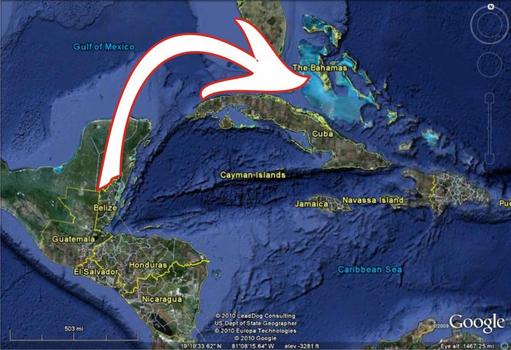
                                                                                  In 2010 ECOMAR received a grant from the Gulf & Caribbean Fisheries Institute's (GCFI) Small Grant Fund to send six representatives from Belize to the Bahamas to learn about lionfish management.   This program was very timely in implementing the Belize Lionfish Program as it allowed Belize fishermen to learn first hand what the Bahamians were doing to manage lionfish so they could return to Belize and share this information with their colleagues.

                                                                                  Belize Bahamas Fisherman Exchange: Lionfish Management Training Program
                                                                                  Picture
                                                                                  The Belize and Bahamas Fishermen Exchange Program funded by the Gulf & Caribbean Fisheries Institute through the United Nations Environment Program (UNEP), Caribbean Environment Program (CEP), and the Caribbean Protected Areas Management Network and Forum (CaMPAM) has been very beneficial to the Belize Lionfish Program as it has enabled Belizean fishermen, the Belize Fisheries Department and ECOMAR to travel to the Bahamas to participate in a Lionfish Training Workshop that was conducted by the Bahamas Department of Fisheries in conjunction with The Nature Conservancyand the Bahamas National Trust.  

                                                                                  The workshop included a classroom training session, field networking with Bahamian fishermen, capturing lionfish and preparing lionfish for consumption. The Belizean fishermen also had opportunity to liaise with the fishermen and organizations involved in managing the lionfish populations in Bahamas.   Due to the widespread invasion of lionfish, the Bahamas Fisheries Department is now developing creative strategies to promote lionfish as a commercial fishery in the hopes of controlling their population.

                                                                                  The fishermen from Belize learned first-hand how their counterparts in the Bahamas are managing this invasive species and how to safely capture, handle and prepare lionfish to consumption.   Back home in Belize the fishermen will be able to share the lessons learned with their counterparts on a day to day basis and also at the workshops that will be held country wide.  Additional goals not expected were also realized and the Belize Bahamas Fishermen Exchange Program is discussed in detail below.

                                                                                  Objectives

                                                                                  The primary objective of the project is to provide Belize fishermen with an opportunity to learn how the Bahamas is managing the lionfish invasion in their waters.  The participants from Belize can then return home and pass this knowledge on to their counterparts in Belize on a day to day basis and also in conjunction with the 12 Lionfish Outreach Workshops that will be held in Belize that is part of the Belize Lionfish Project funded by UNDP COMPACT.  A summary of the Project Objectives, Indicators of Success and Level of Completion are outlined in the table below.

                                                                                  1. Belize fishermen learn how Bahamians are managing invasive lionfish by attending workshop and meeting with fishing community.
                                                                                  2. Belize fishermen learn how to capture, handle and prepare lionfish for sale to wholesale and retail markets.
                                                                                  3. Belize fishermen that participate in the exchange program will share the lessons learned with other fishermen in Belize at the community outreach programs scheduled to take place over the next couple of months.
                                                                                  The Belizean fishermen that participate in GCFI Fisherman Exchange program attended three days of activities organized by Bahamian counterparts.   The workshop included a classroom training session, field networking with Bahamian fishermen, capturing lionfish and preparing lionfish for consumption. The Belizean fishermen also had opportunity to liaise with the fishermen and organizations involved in managing the lionfish populations in Bahamas.   The daily activities undertaken by the group are outline in the section below.

                                                                                  The Bahamas counterparts, The Nature Conservancy and the Bahamas Department of Marine Resources along with the Bahamas National Trust provided three days of activities for the participants of the Belize-Bahamas Lionfish Fishermen Exchange Program.  The events that achieved the project objective are outlined below. 

                                                                                  Day 1: Interaction Between Fisherman: Visits to Seafood Processing Plants & Fish Markets

                                                                                  Picture
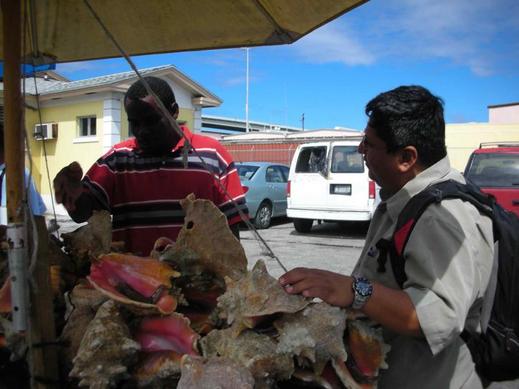
                                                                                  Isaias Majil discussing the conch fishing industry with Bahamas fisherman. It was interesting to observe that in the Bahamas the conchs are sold whole and live, while in Belize they are sold cleaned.
                                                                                  Picture
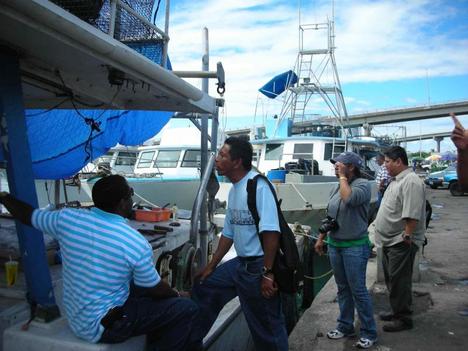
                                                                                  Mr. Eugenio Perez, Ms. Felicity Burrows and Mr. Isaias Majil inspecting the fishing vessels used in the Bahamas at Montagu Ramp. The vessels used in the fishing industry in Belize are considerably smaller than those used in Bahamas.
                                                                                  Picture
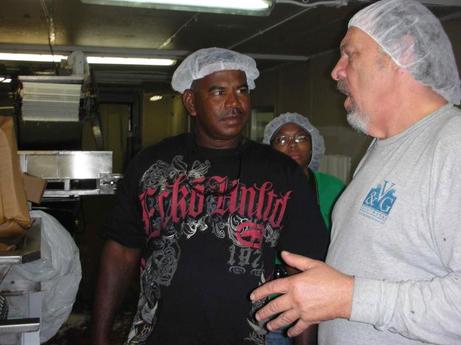
                                                                                  Mr. Gareth Longsworth and Ms. Felicity Burrows at Tropical Seafood of Bahamas seafood processing plant.
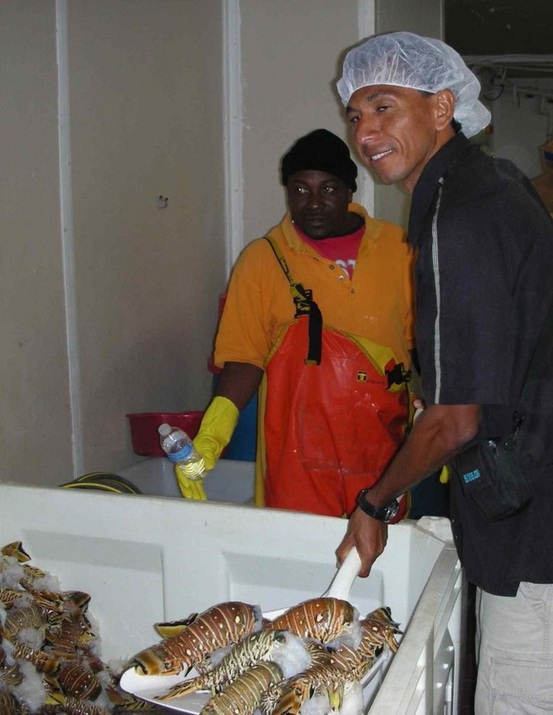
                                                                                  Tropic Seafood of Bahamas facilitated an internal tour of their processing facility. They export primarily to the United States and France and aim in setting processing standards that meet MSC (Marine Stewardship Council) certification. During the participant’s visit, 10,000 pounds of Caribbean spiny lobster were being processed for storage and export. Participants were provided a detailed tour of the sizing and packaging processing unit, the ozone filtration system, the cooling and storage unit and the laboratory.

                                                                                  Paradise Seafood of Bahamas also facilitated an internal tour of their processing facility.  This facility processes about 10,000 pounds of lobster per month with higher numbers at the beginning of the lobster season. Participants were able to get an upfront tour of the sizing, processing and storage units of the facility. The facility technician gave participants an overview of Bahamian islands fishing localities and abundance status.  

                                                                                  Potter’s Caye Dock and Montagu Ramp are two major landing sites for local fisheries; primarily the queen conch, Caribbean spiny lobster and Nassau grouper. The Belize participants along with the Bahamas team spent time interacting with the local fishers inquiring about prices, catch effort and local market dynamics.
                                                                                  Picture
                                                                                  Mr. Armando Ramirez assisting at Tropical Seafood of Bahamas. The Bahamas processed more than 10,000 pounds of lobster during their visit. In discussions with the Bahamas fishermen, they report that their industry is successful because they use scuba in harvesting lobster and are therefore more selective in their take, allowing undersized and those with eggs to remain in the sea.

                                                                                  Day 2 Morning - Lionfish Management Workshop

                                                                                  The Bahamas National Trust hosted a workshop focusing on status and efforts in Bahamas for the invasive lionfish. The Bahamas Marine Resources Department discussed detailed components of their National Lionfish Response Plan and management strategies currently implemented throughout the Bahamian Archipelago. Due to the extent of the lionfish invasion of Bahamian waters, they are now being promoted as a commercial fisheries species and management response consists of safe capture, handling, and cooking initiatives. Discussions for recommendations and planning strategies were opened with the Belize team.

                                                                                  Day 2 Afternoon - Safe Capture of Lionfish

                                                                                  A lionfish field collection exercise was carried out at the Mahoni Wreck, a popular dive site off Paradise Island. The Bahamian team outlined techniques for spearing and proper collection and handling of lionfish. In-water collection was carried out and 11 lionfish were captured and recorded.
                                                                                  Picture
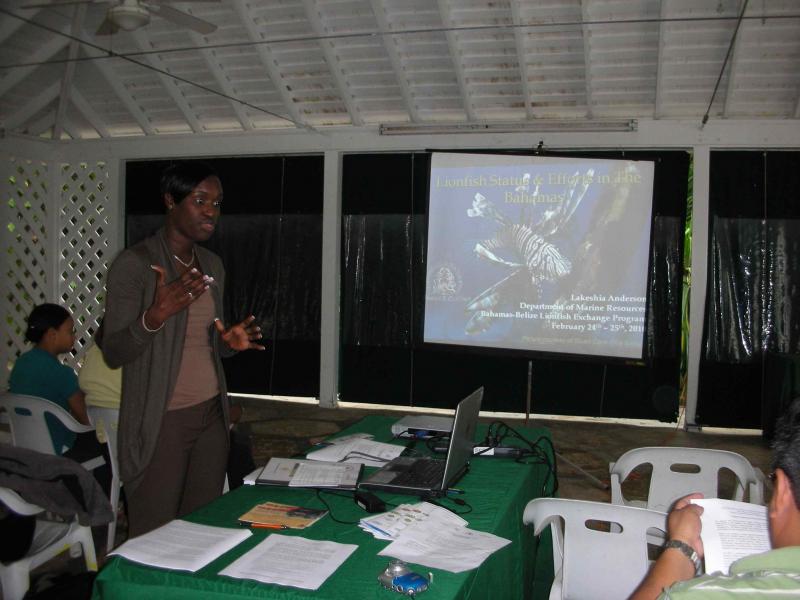
                                                                                  Lakeshia Anderson, Assistant Fisheries Officer with the Department of Marine Resources, presents on lionfish management at morning session of workshop.
                                                                                  Picture
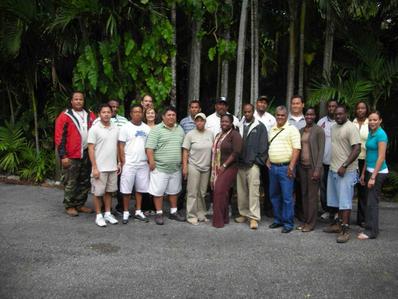
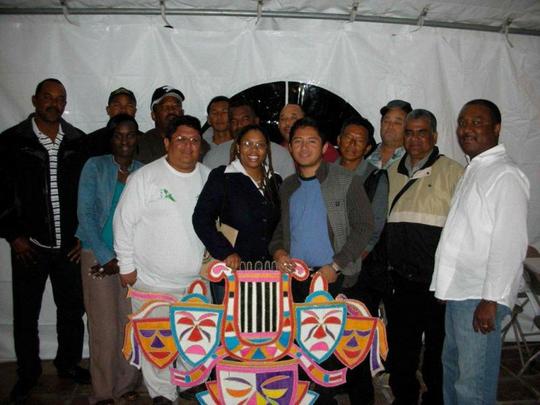
                                                                                  Participants at Bahamas Department of Marine Resources Lionfish Management Training Workshop include the team from Belize, The Bahamas National Trust, The Nature Conservancy, Department of Marine Resources and Tropic Seafood of Bahamas.
                                                                                  Picture
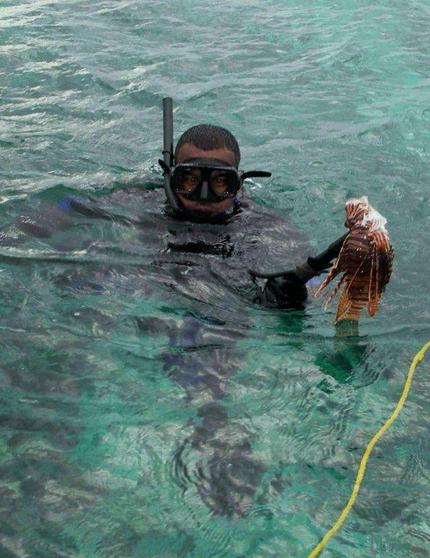
                                                                                  Mr. Gareth Longsworth displays the first lionfish he has captured while diving at Mahoni wreck.
                                                                                  Picture
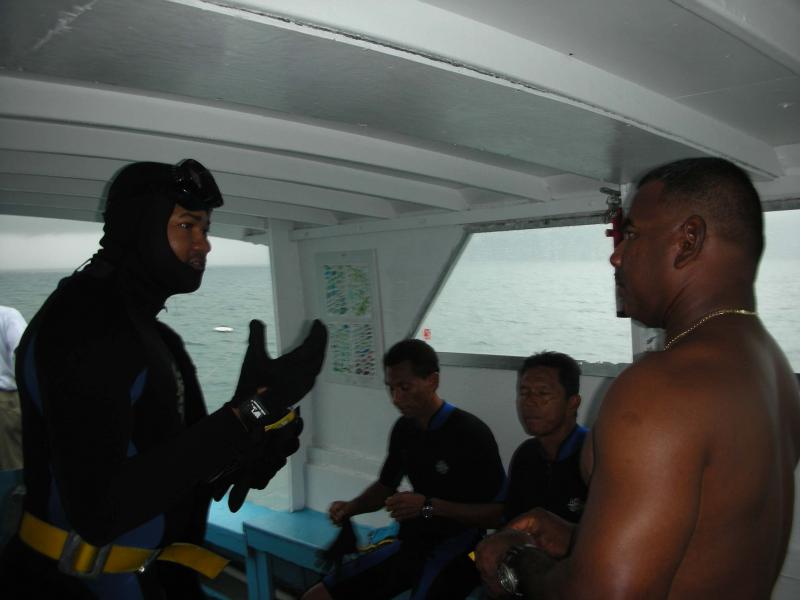
                                                                                  Mr. Jared Dillet describes techniques for proper capture and handling of lionfish underwater to Mr. Armando Ramirez, Mr. Eugenio Perez & Mr. Gareth Longsworth. The Belize team included scuba divers and free divers, while in the Bahamas they primarily dive to harvest lionfish.

                                                                                  Day 3 - Preparation of Lionfish for Consumption

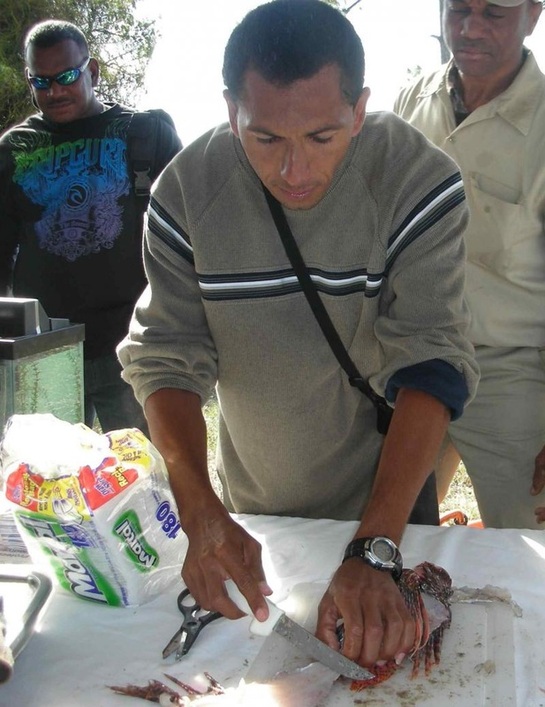
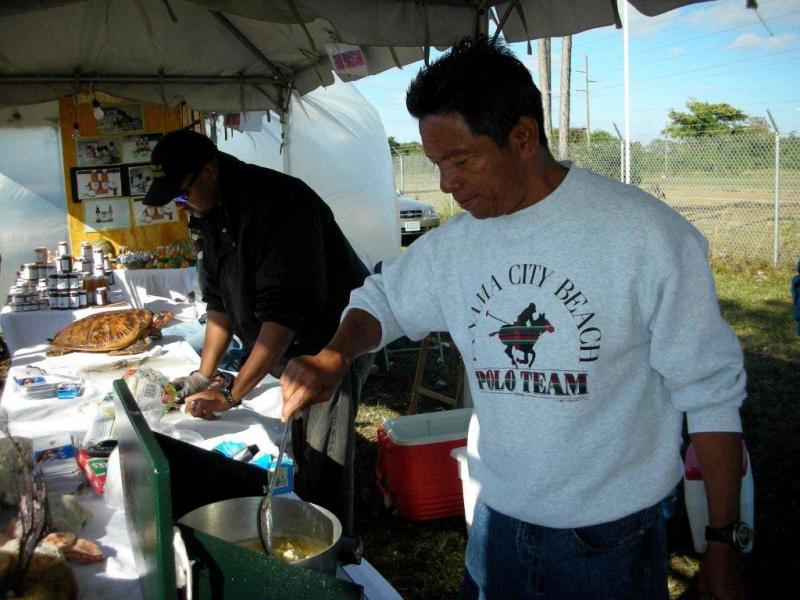
                                                                                  The Marine & Agrobusiness Expo was hosted by the Ministry of Agriculture and Marine Resources. The Department of Marine Resources managed an educational booth for proper handling and cooking of lionfish. The booth provided a unique opportunity for the Bahamian scientists to demonstrate to the Belize fishermen the proper removal of the lionfish venomous spines for safe consumption. The Bahamian scientists also learned filleting techniques from the Belize fishermen which made cleaning the fish quicker. Lionfish samples were available on site for Expo attendees to view and taste.
                                                                                  Picture
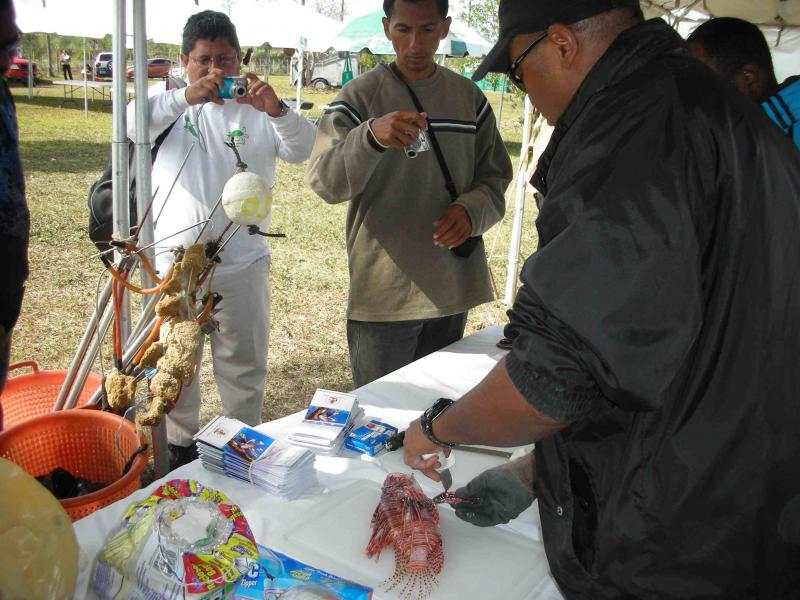
                                                                                  Mr. Isaias Majil and Mr. Armando Ramirez document how the Mr. Jared Dillet prepares lionfish for consumption. The Bahamas Government encourages people to consume lionfish during the spawning season for groupers.
                                                                                  Picture
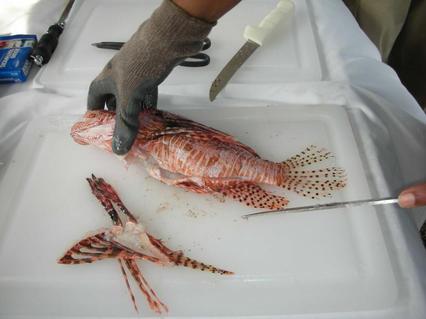
                                                                                  This method includes removing the venomous spines with prior to filleting the lionfish.
                                                                                  Picture
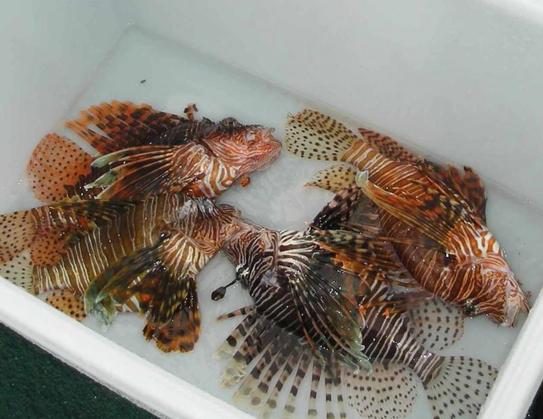
                                                                                  Lionfish captured on their afternoon day in the field at Mahoni Wreck. The lionfish will be prepared for consumption at the Marine & Agrobusiness Expo the following day. A fisherman reported to Mr. Valentine Rosado that he receives orders for lionfish from restaurants and has fishermen capture them. He pays the fishermen US $3.00 per lionfish and resells it for US $7.00.
                                                                                  Picture
                                                                                  Eugenio Perez proudly displaying his first filleted lionfish!
                                                                                  Picture
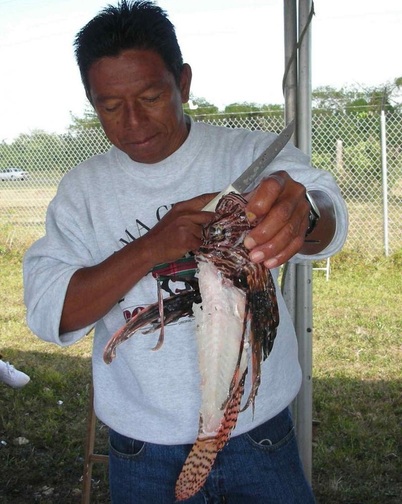
                                                                                  Armando Ramirez preparing lionfish for consumption at the Bahamas Marine & Agrobusiness Expo. The Belize fishermen fillet the lionfish without removing the spines since it is quicker.
                                                                                  Picture
                                                                                  Eugenio Perez cooking his first lionfish for consumption at the Marine & Agrobusiness Expo.
                                                                                  Picture
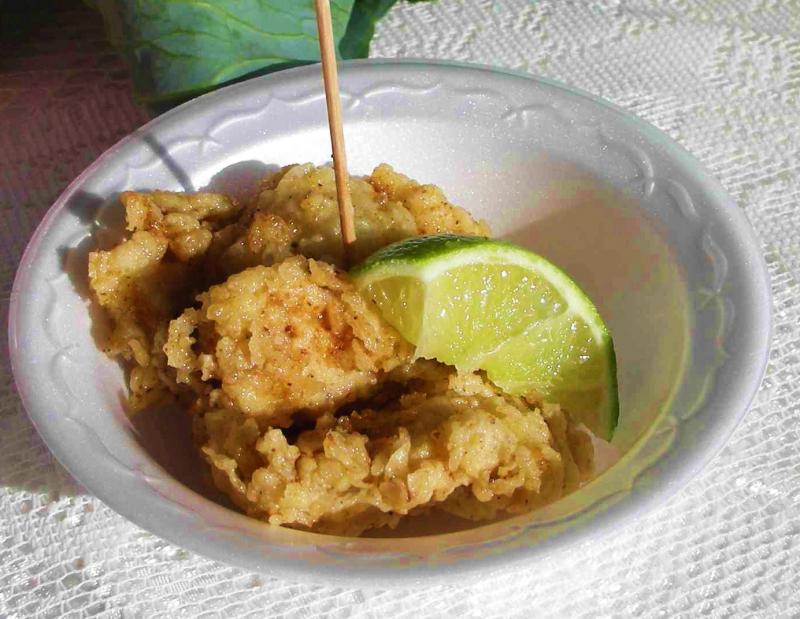
                                                                                  Freshly cooked lionfish prepared by the Belize-Bahamas Fishermen Exchange team. Members of the Belize team say lionfish taste like grouper, but that they were thinner so would need more fish to one grouper. That does not seem to be a problem since the lionfish are already out-competing the native fish species such as the groupers, by their rapid reproductive rate. 

                                                                                  Day 2 Evening - Farewell Reception

                                                                                  Bahamas Commercial Fishers Alliance hosted a reception for Belize team on the eve of their departure. The reception provided an informal opportunity for fishermen interaction. Bahamas fishermen believe fishing with scuba tanks and compressor is beneficial to coral reefs as it maximizes time underwater to catch legal size fisheries products and exact species of commercial fisheries. Belize counterparts provided recommendations and facts from the vantage point of an overfished industry as a consequence of unsustainable fishing practices.
                                                                                  Picture

                                                                                  Acknowledgements

                                                                                  The fishermen and other participants from Belize are very grateful for the opportunity to travel to the Bahamas and learn firsthand how the Bahamas have been managing lionfish as well as to have the opportunity to learn other valuable lessons during exchange program. 

                                                                                  This project would not have been possible without the invaluable assistance provided by Mrs. Lakeshia Anderson and the Bahamas Department of Marine Resources, and Ms. Felicity Burrows, Marine Specialist for The Nature Conservancy in the Bahamas, in the initial planning stages of the Belize-Bahamas Fishermen Exchange – Lionfish Management Training Workshop, and in organizing the workshop and other activities in the Bahamas.  Thanks too to Mr. Fernando Secaira, Marine Specialist for The Nature Conservancy in Mexico, for making the introductions between ECOMAR and their office in the Bahamas.

                                                                                  ECOMAR would also like to thank the team from the Gulf & Caribbean Fisheries Institute (GCFI); especially Dr.  Alejandro Acosta, Mr. Bob Glazer and Dr. Mel Goodwin; the Caribbean Environment Programme (CEP); UNEP (United Nations Environment Programme) and CaMPAM, for awarding a 2010 Small Grant Fund to the Belize-Bahamas Fishermen Exchange – Lionfish Management Workshop, as it has enabled us to improve the Belize Lionfish Project.

                                                                                  Lessons Learned

                                                                                  The GCFI Belize & Bahamas Fishermen Exchange has served as an invaluable opportunity to share lessons learned from the Bahamas lionfish status and management efforts. The Belize delegates have committed to share acquired techniques including collection and management protocols that they will share at outreach workshops that will be held throughout fishing communities in Belize.  The fishermen will also be able to share experiences and knowledge with other community members on a day to day basis.  

                                                                                  The Belize & Bahamas Fishermen Exchange Lionfish Management Training Workshop proved to not only be educational with regards to the original objectives of learning how to safely capture, handle and prepare lionfish, but it also gave the Belize fishermen an opportunity to see firsthand how fishermen in the Bahamas are organized and manage their fishery resources.  Each participant in the exchange program reported that the exchange program was very informative and they were extremely thankful for having participated in the program.

                                                                                  The knowledge learned in the Bahamas will be used in implementation of the Belize Lionfish Project.  Interviews will be conducted with the participants of the program and will be used in developing the Belize Lionfish Project’s Public Service Announcement in Belize.  The participants will also assist at the lionfish outreach workshops that will be held through Belize from April - July 2010 in Belize.

                                                                                  This exchange program has positively impacted the Belize Lionfish Program that is currently underway and has enabled ECOMAR to provide an additional activity that compliments the program as it provided the hands on training needed for successful implementation of the outreach workshops.

                                                                                  They would also have the opportunity to liaise with the fishermen and organizations involved in managing lionfish populations in the Bahamas and gain knowledge on how this invasive species can be managed in Belize.

                                                                                  Due to the widespread invasion of lionfish, the Bahamas Fisheries Department is now developing creative strategies to promote lionfish as a commercial fishery in the hopes of controlling their population.   Belize and the rest of the Atlantic Ocean nations will also have to address the invasive lionfish over the years and projects like the Belize-Bahamas Fishermen Exchange will enable countries to liaise and learn from one another.

                                                                                  Unexpected Lessons Learned - Impacts of Tourism

                                                                                  While traveling around Nassau, Bahamas the Belize team members had the opportunity to note similarities between the two countries.  One similarity is that both economies rely on healthy marine resources and the tourism industry.  Many fishermen in Belize are becoming tour guides as fishery stocks decline.  That the Belize fishermen have witnessed firsthand how important the tourism industry is to the Bahamas, they can possibly envision the progress that some areas of Belize may soon experience with increased tourism.

                                                                                  Participants

                                                                                  Persons involved in the initial project planning and organization include:

                                                                                  Linda Searle
                                                                                  Director
                                                                                  ECOMAR

                                                                                  Lakeshia Arnold
                                                                                  Assistant Fisheries Officer
                                                                                  Bahamas Department of Marine Resources

                                                                                  Felicity Burrows
                                                                                  Marine Conservation Specialist
                                                                                  The Nature Conservancy
                                                                                  Others from the Bahamas who assisted in the project planning and implementation include:

                                                                                  Jared Dillet
                                                                                  Assistant Fisheries Officer
                                                                                  Bahamas Department of Marine Resources

                                                                                  Caswelt Mounts
                                                                                  Fisheries Superintendent
                                                                                  Bahamas Department of Marine Resources

                                                                                  Adrian Laroda
                                                                                  Bahamas Fishermen Cooperation
                                                                                  The group of persons that traveled from Belize to participate in the Fishermen Exchange program included four representatives from four fishing cooperatives, one person representing the Belize Fisheries Department and one representative from ECOMAR, project organizer.  

                                                                                  Guadelupe V. Rosado
                                                                                  Director ECOMAR
                                                                                  CORAL Belize Field Rep

                                                                                  Isaias Majil
                                                                                  Marine Protected Areas Coordinator
                                                                                  Belize Fisheries Department
                                                                                  Eugenio Perez
                                                                                  Member
                                                                                  National Fishermen’s Producers Cooperative

                                                                                  Ovel Leonardo
                                                                                  Chairman
                                                                                  Northern Fishermen’s Producers Cooperative

                                                                                  Gareth Longsworth
                                                                                  Member
                                                                                  Placencia Fishermen’s Producers Cooperative

                                                                                  Armando Ramirez
                                                                                  Vice Chairman
                                                                                  Rio Grande Fishermen’s Producers Cooperative
                                                                                  Picture
                                                                                  Picture
                                                                                  Picture
                                                                                  Picture
                                                                                  Picture
                                                                                  Picture

                                                                                  Contact Details

                                                                                  Picture
                                                                                  PO Box 1234
                                                                                  Belize City, Belize
                                                                                  TEL: + (501) 223-3022
                                                                                  CEL: + (501) 671-3483
                                                                                  Email: linda@ecomarbelize.org

                                                                                  Like us on Facebook!

                                                                                  Picture