
Photo courtesy Linda Searle
dolphins
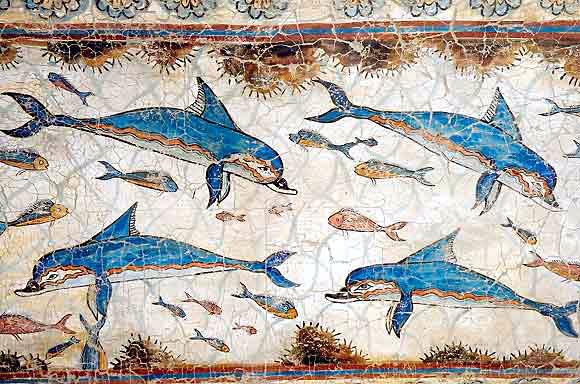
Fresco of Dolphins, ca. 1600 BC, from Knossos, Crete. Wikipedia

"Often times we find groups of dolphins clustered together tightly with their associates. Boats can elicit a variety of behaviors from these animals, and one of the more common behaviors we observe is that the animals approach the boat while producing loads of high-pitched whistles"
Eric Ramos "Bottlenose dolphin "Pack" inspects our boat during research surveys in Turneffe Atoll, Belize"
Eric Ramos "Socializing dolphins often encircle each other during sexual behavior, emitting series of buzzes and whistles as they prod each other with their beaks. In this clip the three active dolphins in the center of the frame are engaged in what is known as “goosing” or rostra-gential contact and “genital buzzing”, with streams of bubbles emitted after buzzes"
Eric Ramos |
VALUE
Dolphins have been valued over the centuries for enjoyment, consumption and deployment. Seeing dolphins is thought to be a good omen by early Greeks, while in Japan and the Faroe Islands they are part of the local people's diet. The military of several governments also train dolphins to conduct underwater missions. They are intelligent animals and have characteristics displayed by humans including the ability to teach, learn, cooperate, scheme, and grieve. There are several common species in Belize:
In Belize Atlantic bottlenose dolphins are found through the inshore coastal lagoon and open ocean. Passengers on boats and scuba divers always marvel when dolphins are encountered at sea. Wildlife Encounter Tours offered by tour operators specifically seek out dolphins. The value of dolphins to the tourism industry in Belize has not yet been valued, but dolphin watching is important industry for other coastal cities in tourism destinations. LEAD RESEARCHER
Eric Angel Ramos is a third-year Ph.D. student in Animal Behavior and Comparative Psychology at The Graduate Center, City University of New York. Eric has worked as a field scientist leading research trips with students and volunteers to study the behavior of bottlenose dolphins (Tursiops truncatus) and Antillean manatees (Trichechus manatus manatus) at Turneffe Atoll in Belize as a member of Dr. Diana Reiss’ lab at Hunter College and a field scientist for Oceanic Society since 2011. During his master’s thesis research at Hunter College, Eric investigated the use of foraging-related calls by the small population of bottlenose dolphins at Turneffe Atoll Marine Reserve (TAMR) in Belize, providing the first report of this acoustic call in dolphins and demonstrated its contextual use during bottom foraging by a subset of the population. This year Eric and his colleagues authored a review of the aquatic mammals of Belize that was accepted for publication to the journal Aquatic Mammals. They provided the first systematic review of aquatic mammals in the region and verified the occurrence of 17 aquatic mammal species in Belizean waters, reporting numerous species for the first time in the Western Caribbean. For his dissertation Eric is investigating the impacts of vessel activity on the behavior and fitness of marine mammal populations in Belize using Unmanned Aerial Systems (UAS)—or drones. His research interests include the behavioral ecology, communication, and conservation of marine mammals throughout the Western Caribbean. OBSERVATIONS
Eric explains, "These recordings were gathered during boat-based surveys at Turneffe Atoll. When animals were sighted from the boat, we carefully approached to take photo identification images of their dorsal fins, estimate group size, and conduct behavioral observations. We attached a GoPro HD Hero 3 camera to a pole and fixed it to the side of the boat so that it could swivel. One volunteer manually maneuvered the camera in the direction of the dolphins so we could opportunistically observe their behavior when they came near the boat." Links to dolphin research in Belize
Dolphin Research in the Port Honduras Marine Reserve by TIDE Video Notes on Dolphin Behavior by the Oceanic Society |